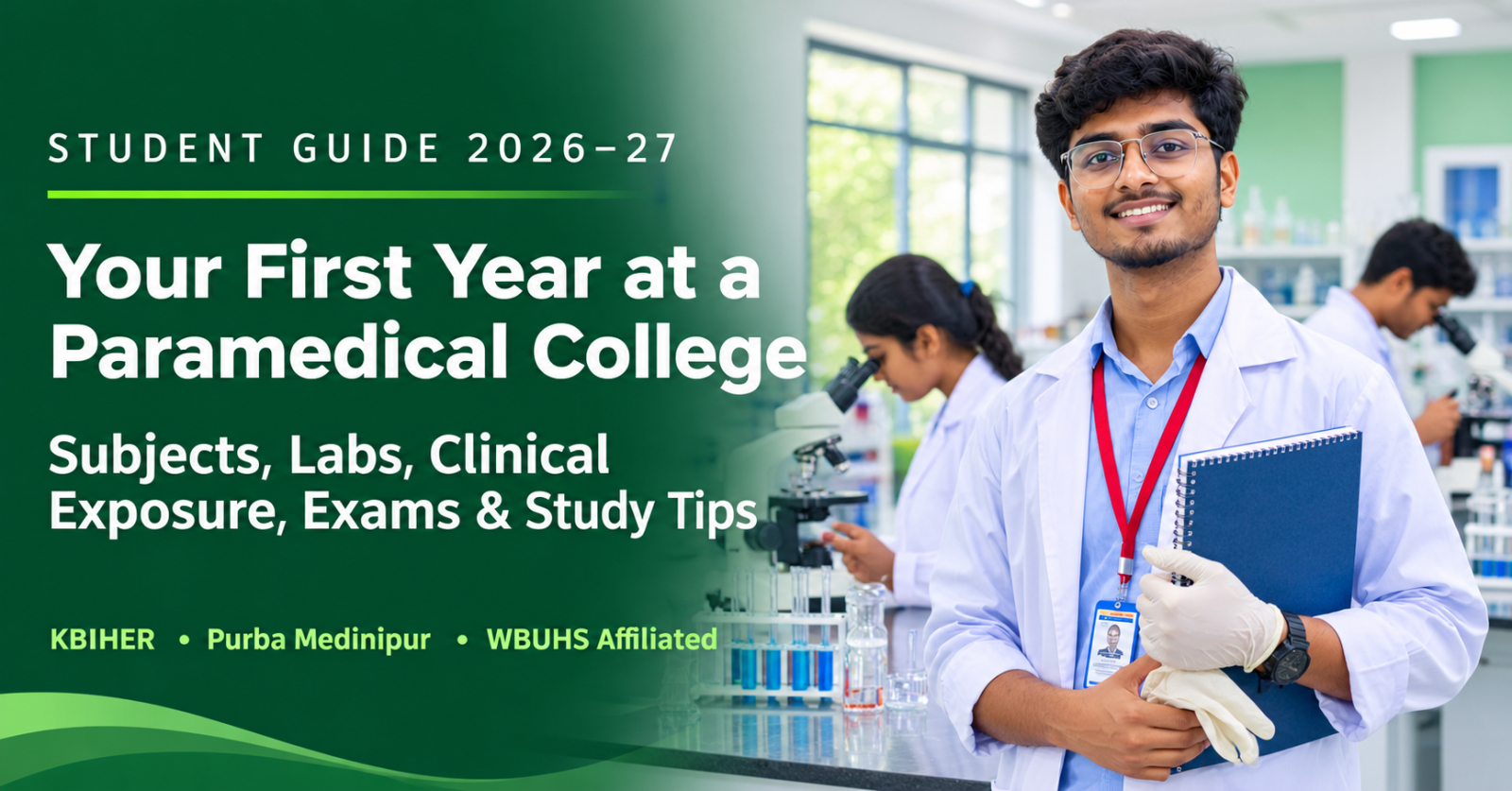
The admission is confirmed and the fees are paid. Your new lab coat is still stiff from the packet. Now a different question shows up: what actually happens next?
For most students, the first year of a paramedical degree is unlike anything in school. The vocabulary is new, the labs are real, and you are expected to manage your own learning. Students who know what is coming settle in quickly. Students who don’t often spend their first semester feeling lost.
This guide is for the 2026–27 batch at KBIHER, Purba Medinipur, and for anyone still deciding whether an allied health degree is right for them. It covers the first year honestly, including what you will study, how the days run, and the habits that separate confident second-year students from struggling ones.
1. The First Few Weeks: Orientation and Adjustment
Your first days are about getting your bearings. Expect an orientation programme that introduces the faculty, the departments, the library and the laboratories. You will also go through college rules, attendance norms and the academic calendar.
A few things to sort out early:
- Collect your ID card, timetable and syllabus. The class routine is published on the college website, and the syllabus follows West Bengal University of Health Sciences (WBUHS) guidelines.
- Learn the attendance rules. Health science universities take attendance seriously, and falling short can affect your eligibility to sit for examinations.
- Know who your coordinator is. Each programme has a faculty coordinator. This is the person to go to first with academic questions.
- Get your lab essentials. Lab coat, closed shoes, a practical record notebook and basic stationery. Your department will tell you about anything specific to your course.
It is normal to feel overwhelmed at first. Nearly every senior student will tell you the first month was the hardest, and that it got much easier after that.
2. What You Will Study in Year One
Whether you have joined BMLS, BEMT, BAOTT or BPT, the first year is built on foundation sciences. You cannot understand disease, diagnosis or therapy until you understand how the healthy body works. Typical first-year subjects across allied health programmes include:
- Human Anatomy: The structure of the body, its bones, muscles, organs and systems.
- Human Physiology: How those systems work, from blood circulation to nerve signals and breathing.
- Biochemistry: The chemical processes inside the body, the basis of most laboratory tests.
- Foundation and supporting subjects: These can include basic pathology or microbiology, communication skills, computer basics and introductory subjects specific to your programme.
BHA students follow a different track. Their first year focuses on the foundations of management, healthcare systems, communication and the basics of how a hospital is organised.
Tip: Always check the official WBUHS syllabus for your programme and semester. It tells you exactly what will be examined, so treat it as your study map.
3. Labs and Practicals: Where Theory Becomes Skill
This is the part most students enjoy most. KBIHER’s laboratories let you handle real instruments from the early semesters, and practical work is a major part of your assessment.
In your first year you can expect to:
- Learn how to use and care for a microscope correctly
- Study anatomical models, charts and specimens
- Perform basic physiology and biochemistry experiments
- Maintain a practical record book, which is checked and counts towards assessment
- Follow lab safety rules: handling samples, disposing of waste, hand hygiene and personal protection
Do not treat the practical record as an afterthought. Write each experiment up the same week you do it. Students who leave records until the end of the semester lose marks and sleep.
4. Your First Taste of Clinical Exposure
KBIHER is clinically attached to Tamralipto Government Medical College & Hospital, and this is one of the biggest advantages of studying here. Clinical training builds steadily through the course, and the early exposure matters.
Your first visits to a hospital setting help you:
- See how departments such as the laboratory, ICU, OT and physiotherapy unit actually run
- Understand the role your profession plays in the larger healthcare team
- Observe professional conduct, patient communication and infection control in real situations
Go into every visit with a notebook and questions. Watch how experienced technologists and therapists talk to patients. That skill is not in any textbook, and it is one of the most valuable things you will learn.
5. Exams and Assessment: How the System Works
As a WBUHS-affiliated college, KBIHER follows the university’s examination structure. In general, your performance is judged on a mix of:
- Internal assessment: Class tests, assignments, practical records, attendance and conduct through the semester
- University examinations: Theory papers and practical or viva examinations conducted as per WBUHS norms
What this means for you is simple: consistency beats last-minute effort. Internal marks are earned week by week, and the viva rewards students who actually understand their practicals, not those who memorised the night before.
Keep an eye on the Notices & Announcements section of the KBIHER website for exam schedules, form fill-up dates and university notifications.
6. Study Habits That Work in Health Sciences
School-style memorisation does not survive long in anatomy and physiology. These habits do:
- Review the same day. Spend 30 minutes going over each day’s lectures that evening. Small daily reviews beat weekend marathons.
- Draw it. Diagrams of the heart, nephron or brachial plexus stick in memory far better than paragraphs. Examiners value good diagrams too.
- Learn the terminology early. Medical words are built from Latin and Greek roots. Learn the common prefixes and suffixes and hundreds of terms become easy.
- Use the library. Standard reference books are expensive. Borrow them, and buy only what your faculty specifically recommends.
- Form a small study group. Explaining a concept to a friend is the fastest way to find out whether you really understand it.
- Ask questions in class. KBIHER’s faculty are approachable. A doubt cleared in week two saves hours of confusion in week ten.
7. Money Matters: Don’t Miss These Deadlines
The first year is also when many families sort out funding. If you are eligible, make sure these are on your calendar:
- SVMCM Scholarship: Applications are made online at svmcm.wb.gov.in and must be verified by the institution. Remember that it needs renewing every year.
- West Bengal Student Credit Card: Applied for through wbscc.wb.gov.in, for students who need a low-interest education loan.
- Category-specific scholarships: SC, ST, OBC and minority students should check the relevant state schemes.
Fees at KBIHER are paid at the beginning of each semester, and university examination and registration fees are paid separately as per WBUHS norms. Keep every receipt in one folder. You will need them for scholarship and loan verification. For a detailed walk-through, read our guide How to Fund Your Paramedical Degree in West Bengal on the KBIHER blog.
8. Look After Yourself, Too
A healthcare career is about caring for others, and that starts with looking after yourself.
- Sleep properly. Tired students learn slowly and make mistakes in the lab.
- Eat regular meals, especially on long practical days.
- Stay active. Make use of the campus sports facilities.
- Talk to someone if you are struggling, whether that is a faculty member, a senior or your family. Asking for help early is a sign of maturity, not weakness.
- Join in. Workshops, seminars, observance days and social outreach activities build confidence and help you make friends.
Frequently Asked Questions
Is the first year of a paramedical course very difficult?
It is different from school rather than impossibly hard. Anatomy, physiology and biochemistry carry a lot of new terminology, but with regular daily study and good attendance most students adjust within the first few months.
Do first-year students get hospital exposure at KBIHER?
Yes. KBIHER is clinically attached to Tamralipto Government Medical College & Hospital, and students are introduced to clinical settings as part of their training, with exposure increasing as the course progresses.
I am from a PCM background. Will I struggle with biology-heavy subjects?
Students from a PCM background are eligible for BMLS, BEMT and BAOTT. You may need to put in extra effort at the start, but the foundation subjects are taught from basics. Ask your faculty for recommended starter books and use the library well.
Where can I find my syllabus and class routine?
Both are available on the KBIHER website under the Academics and Student Corner sections. You can also get them from your programme coordinator.
What happens if my attendance falls short?
Attendance requirements are set as per university norms, and a shortfall can affect your eligibility for examinations. If you are facing a genuine problem such as illness, inform your coordinator early.
A Strong First Year Builds a Strong Career
Every skilled laboratory scientist, emergency technologist, OT technologist, physiotherapist and hospital administrator was once a nervous first-year student. The difference is in the habits built during these first months: showing up, keeping up and asking questions.
Welcome to the start of your healthcare journey. We are glad you are here.
Still Deciding? Admissions & Enquiries at KBIHER
- Website: www.kbiher.in
- Call / WhatsApp: +91 7479034180 | +91 7479034181
- Email: kbiher2022@gmail.com
- Campus: Tajpur, Mahishadal, Purba Medinipur – 721628, West Bengal
Academic rules, syllabus and examination patterns are governed by WBUHS and may be revised from time to time. Please confirm current details with the college office or the official WBUHS website.
Ready to Begin Your Healthcare Career?
Applications for 2026–27 are open. Limited seats available at KBIHER, Medinipur.