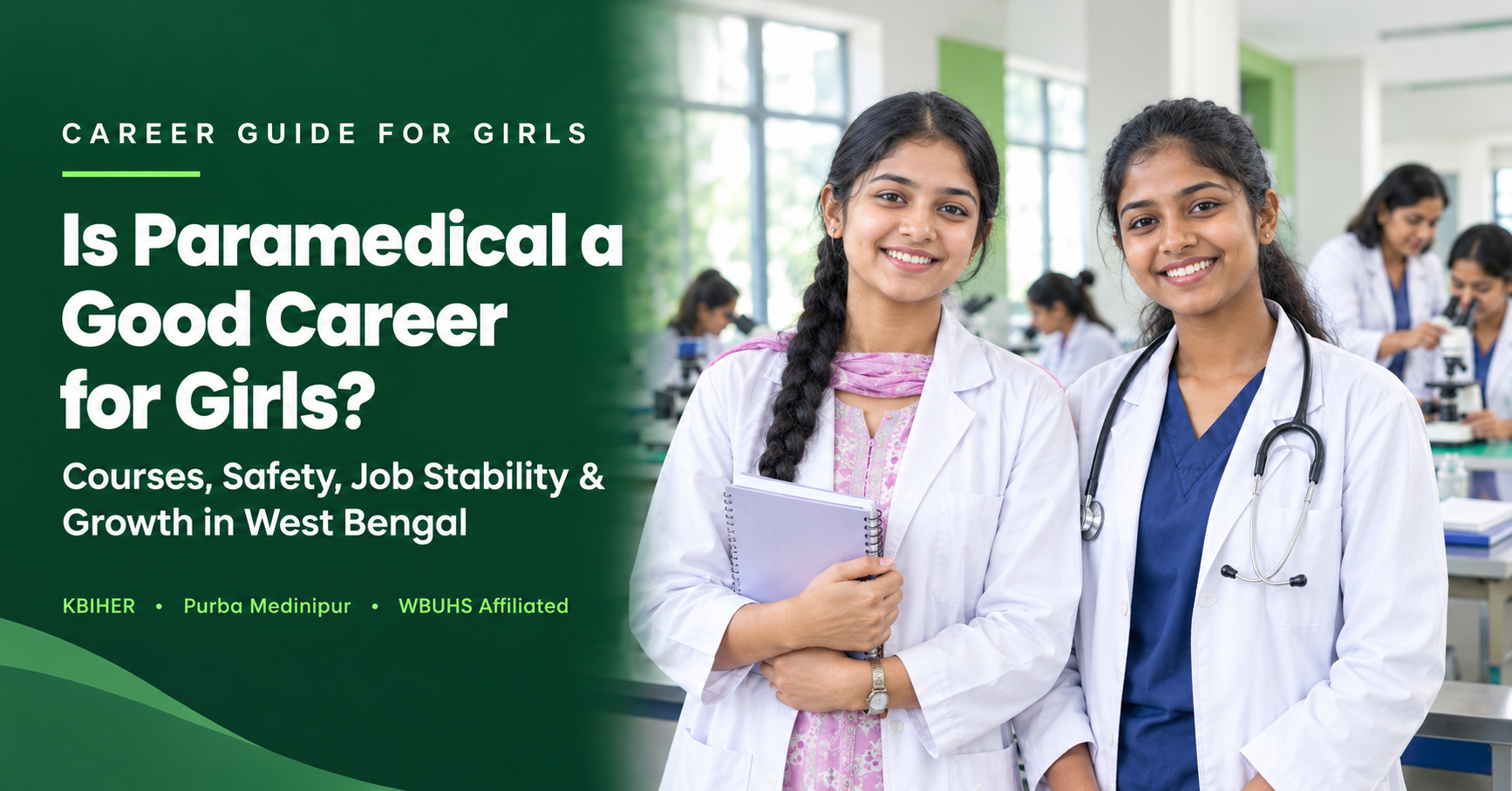
When a daughter finishes Higher Secondary, many families in West Bengal sit down to the same discussion. What should she study? Will the job be stable? Is the work environment safe? Can she study close to home?
More and more families are finding that a paramedical (allied health) career answers these questions well. Women already make up a large share of India’s healthcare workforce, and allied health offers respected, skilled and stable work for girls from both towns and villages.
This guide is for students and especially for parents. It covers the questions families ask most, honestly and clearly.
Why Paramedical Careers Suit Girls Well
1. Respected, professional work
Allied health professionals are trained specialists. A laboratory scientist, physiotherapist, OT technologist or hospital administrator holds a respected position in the healthcare team and in the community.
2. Steady demand
Hospitals, diagnostic centres and clinics need trained allied health staff all year round. As India’s healthcare system grows, demand for qualified professionals keeps rising in both cities and districts.
3. Jobs available close to home
Healthcare exists everywhere: district hospitals, nursing homes, diagnostic labs and rehabilitation centres. Many graduates find work in or near their home district, which matters a great deal to many families.
4. Financial independence
A professional degree gives a young woman her own income and career identity, and the confidence that comes with it.
5. A career that lasts
Healthcare skills don’t go out of date the way some jobs do. Professionals can work for decades, return after a career break, or move into teaching, supervision or their own practice.
Which Paramedical Course Is Right for Her?
All five programmes at KBIHER are open to both girls and boys. Each one suits different interests:
| Programme | Best for a student who… | Typical work settings |
|---|---|---|
| BMLS (Medical Laboratory Science) | Enjoys science, precision and lab work | Hospital labs, diagnostic centres, blood banks, research labs |
| BPT (Bachelor of Physiotherapy) | Likes helping people recover and enjoys personal patient interaction | Hospitals, rehab centres, sports clinics, own practice |
| BHA (Hospital Administration) | Has leadership, planning and people-management skills (any stream) | Hospital offices, front office, quality, HR and operations departments |
| BAOTT (Anaesthesia & OT Technology) | Is calm, focused and fascinated by surgery | Operation theatres, day-care surgery centres |
| BEMT (Emergency Medical Technology) | Thrives in fast-paced, high-responsibility settings | ICUs, CCUs, emergency departments |
For families who prefer regular hours: BMLS and BHA roles often include day-shift and office-hour positions, especially in diagnostic chains and hospital administration. Physiotherapy also offers flexible options, including private practice. ICU and OT roles usually involve shift duty, as in most hospital clinical work.
Questions Parents Ask Most
“Is the work environment safe for girls?”
Hospitals are structured, supervised workplaces with clear protocols, security staff and teams working together. Students are trained in professional conduct and workplace safety, and reputed hospitals have policies to protect their staff. As with any career, choosing a well-established employer matters.
“Will she have to do night shifts?”
It depends on the role. Clinical areas like ICU and OT run around the clock, so shift duty is common there. Many roles in laboratories, diagnostics, physiotherapy and administration offer day shifts. Choosing the right programme gives families flexibility.
“Can she continue working after marriage?”
Yes. Healthcare is one of the most transferable careers there is. Hospitals and labs exist in every district and city, so a qualified professional can find work wherever the family settles.
“Is it suitable for a girl from a village or small town?”
Absolutely. Many of KBIHER’s students come from towns and villages across Purba Medinipur and neighbouring districts. Studying in a district setting is often more comfortable and affordable than moving to Kolkata.
“What if she wants to study further?”
She can pursue an M.Sc. in her specialisation, an MPT in physiotherapy, or an MHA or MBA in healthcare management. After postgraduate study, teaching and research careers also open up.
Real Advantages of Studying Close to Home
For many families, distance is a deciding factor. Studying at a college like KBIHER in Tajpur, Mahishadal, Purba Medinipur offers clear benefits:
- Lower living costs than metropolitan cities
- Easier travel home on weekends and holidays
- A familiar environment that helps students settle in and focus
- The same university standard. All KBIHER programmes are affiliated with WBUHS, the same state health sciences university that governs allied health education across West Bengal.
Financial Support Families Should Know About
Cost should not be the reason a capable girl gives up a healthcare career. Families should look into:
- Swami Vivekananda Merit-cum-Means Scholarship (SVMCM) for eligible meritorious students
- West Bengal Student Credit Card, a low-interest education loan without collateral
- Kanyashree-linked benefits for eligible girl students
- SC, ST, OBC and minority scholarships under state schemes
Always check current eligibility on the official portals. For a full walk-through, read our guide How to Fund Your Paramedical Degree in West Bengal on the KBIHER blog.
What Makes KBIHER a Comfortable Choice for Girls
- WBUHS-affiliated, DME-approved programmes with recognised degrees
- A supportive campus environment with approachable faculty, including many women faculty members
- Clinical training at Tamralipto Government Medical College & Hospital under proper supervision
- Modern labs and facilities for hands-on learning
- Placement support to help students start their careers with reputed hospitals
- Affordable fees with semester-wise payment
Frequently Asked Questions
Which is the best paramedical course for girls?
There isn’t one “best” course. It depends on her interests. BMLS suits students who love lab science, BPT suits those who enjoy helping patients recover, and BHA suits students interested in management. All five programmes at KBIHER welcome girls.
Can a girl from an Arts or Commerce background join a paramedical course?
Yes. Bachelor in Hospital Administration (BHA) at KBIHER is open to students from any stream with a minimum of 45% in 10+2, along with the mandatory JENPAS exam.
Do girls need NEET for paramedical courses?
No. Admission to KBIHER’s allied health programmes is through the JENPAS (UG) exam along with the required 10+2 marks. NEET is not required.
Is physiotherapy a good career for women?
Yes. Physiotherapy offers hospital jobs, rehab centre roles and the option of running a private clinic, which gives women real flexibility in how and where they work.
Can parents visit the campus before admission?
Yes. Families are welcome to visit the KBIHER campus, meet the admissions team and see the labs and facilities before deciding.
Her Future in Healthcare Starts Here
A paramedical career gives a young woman skills that matter, work that earns respect and the independence to shape her own future. With the right course and the right college, she can build a career that lasts a lifetime.
Parents, if you have questions, we encourage you to visit with your daughter, meet our faculty and see the campus for yourselves.
Admissions & Campus Visits – KBIHER
- Website: www.kbiher.in
- Call / WhatsApp: +91 7479034180 | +91 7479034181
- Email: kbiher2022@gmail.com
- Campus: Tajpur, Mahishadal, Purba Medinipur – 721628, West Bengal
Scholarship rules, eligibility criteria and work conditions vary by scheme, employer and year. Please verify current details on official portals and with employers directly.
Ready to Begin Your Healthcare Career?
Applications for 2026–27 are open. Limited seats available at KBIHER, Medinipur.