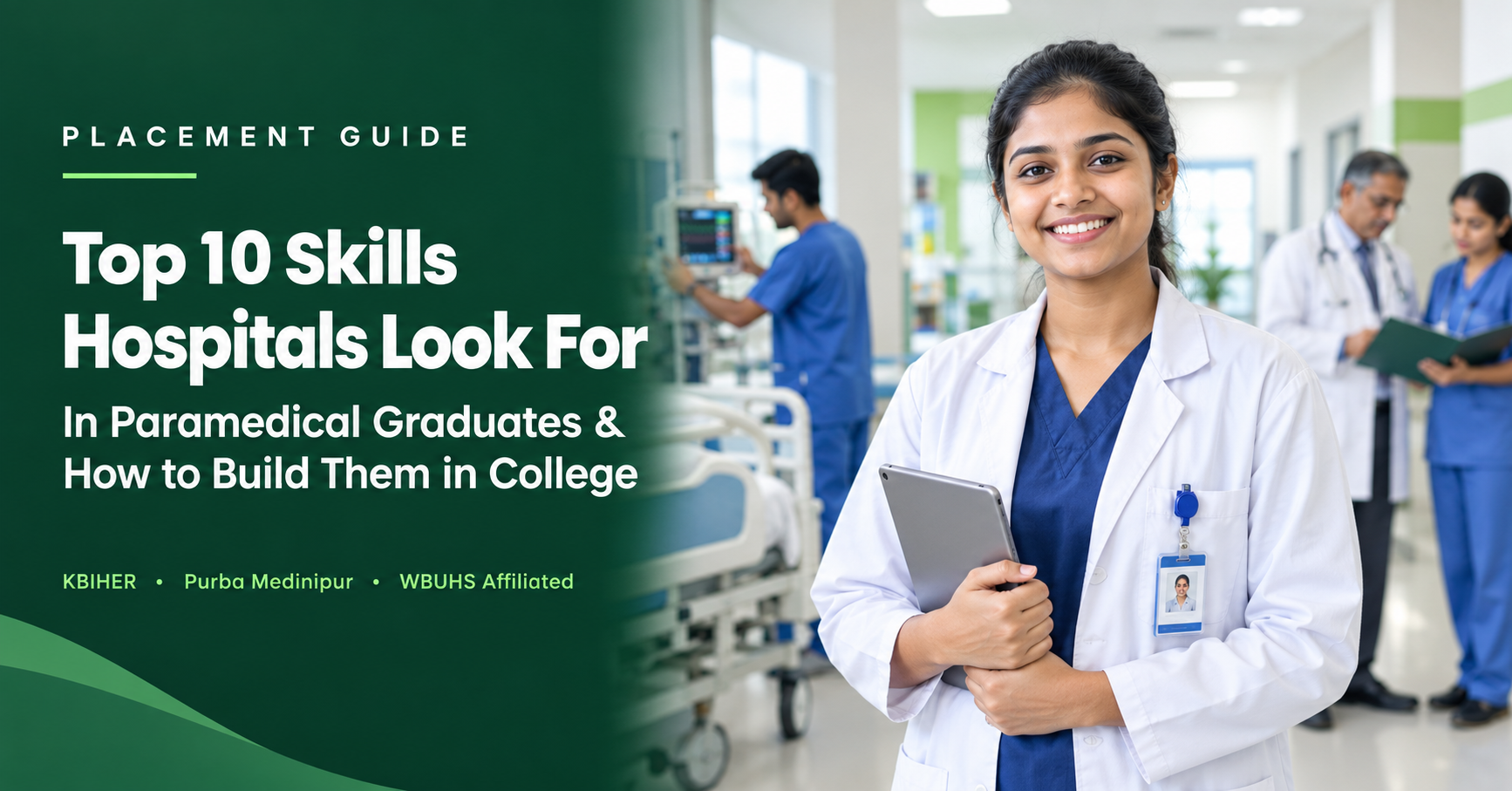
Two students graduate from the same programme with almost the same marks. One gets a job offer from a reputed hospital within weeks. The other keeps waiting.
The difference is usually not the degree. It is the skills the hospital saw during the interview, the internship or the practical test.
Hospitals today don’t just ask “Do you have the qualification?” They ask “Can you do the work safely and work well with our team from day one?” The good news is that every one of these skills can be built during college if you start early.
Here are the 10 skills that matter most, and how to develop each one while you study.
1. Strong Practical and Technical Skills
This is the foundation. A hospital wants to know that you can actually handle the work of your profession:
- BMLS: Sample collection, processing, staining, using analysers and reading results accurately
- BEMT: Ventilator set-up, cardiac monitoring, airway management and emergency response
- BAOTT: OT preparation, instrument handling, sterilisation and anaesthesia equipment checks
- BPT: Assessment techniques, exercise therapy and electrotherapy equipment
- BHA: Hospital information systems, records management and department coordination
How to build it: Treat every practical session like a job rehearsal. Ask to repeat procedures until they feel natural. KBIHER’s labs and clinical attachment with Tamralipto Government Medical College & Hospital give you the hands-on hours you need, so make full use of them.
2. Accuracy and Attention to Detail
In healthcare, small mistakes carry big consequences. A mislabelled sample, a wrong ventilator setting or a missed instrument count can put a patient at risk. Hospitals value people who check, double-check and never cut corners.
How to build it: Keep your practical record neat and complete. Follow every step of a protocol, even when nobody is watching. Accuracy is a habit, not a talent.
3. Infection Control and Patient Safety
Every hospital department follows strict rules on hand hygiene, sterilisation, protective equipment and biomedical waste disposal. Graduates who already follow these rules naturally are much easier to train and trust.
How to build it: Learn the safety protocols in your labs thoroughly, and watch how they are followed during clinical postings. Make proper hand hygiene automatic.
4. Communication Skills
You will speak with patients who are scared, families who are worried, and doctors who are busy. Clear, calm and respectful communication is one of the most valued skills in any hospital.
This includes:
- Explaining a procedure to a patient simply
- Reporting findings to a doctor clearly and correctly
- Writing proper notes and records
- Speaking comfortably in English, Bengali and Hindi where needed
How to build it: Join seminars, present in class and volunteer to speak. Practise explaining one concept from your subject in simple language every week.
5. Teamwork
No healthcare professional works alone. A surgery needs surgeons, anaesthetists, OT technologists and nurses working as one team. An ICU runs on constant coordination. Hospitals look for graduates who cooperate, share information and respect every member of the team.
How to build it: Take group projects seriously, help classmates in practicals, and observe how hospital teams communicate during your postings.
6. Calmness Under Pressure
Emergencies don’t wait. Critical care, operation theatres and emergency departments need people who stay focused when things get tense. Panic causes mistakes. Calm saves lives.
How to build it: Confidence comes from preparation. The more often you practise a procedure, the calmer you will be when it is real. Mock drills and simulation sessions help a great deal.
7. Professional Ethics and Patient Dignity
Hospitals trust you with private information and vulnerable people. They expect you to respect confidentiality, consent and the dignity of every patient, regardless of background.
How to build it: Take your ethics classes seriously and notice how experienced professionals treat patients. Never discuss patient details casually, even with friends.
8. Basic Computer and Documentation Skills
Modern hospitals run on digital systems: laboratory information systems, electronic health records, billing software and online reporting. Graduates who are comfortable with computers adapt much faster.
How to build it: Learn the basics of MS Word, Excel and email. Get comfortable typing and filling digital forms. BHA students in particular should get familiar with hospital management software concepts.
9. Discipline and Reliability
Being on time, completing your shift properly and following the duty roster may sound basic, but hospitals value it enormously. A reliable team member is worth more than a brilliant but careless one.
How to build it: Your attendance record in college is your first reference. Be punctual for classes, practicals and clinical postings. Supervisors notice, and they often remember during placements.
10. Willingness to Keep Learning
Medical technology and guidelines change constantly. Hospitals prefer graduates who are curious, ask questions and want to grow, whether through workshops, certifications or higher studies.
How to build it: Attend workshops and seminars, read about new developments in your field, and consider short certifications alongside your degree. Your curiosity will show in interviews.
Quick Self-Check: Are You Placement-Ready?
Ask yourself these questions in your final year:
- Can I perform the core procedures of my course confidently without help?
- Do I know the infection control rules of my department by heart?
- Can I explain my role to a patient in simple words?
- Is my attendance and practical record something I’m proud of?
- Can I introduce myself confidently in an interview?
If you answer “not yet” to any of these, you still have time. Start working on it today.
How KBIHER Helps You Build These Skills
KBIHER’s programmes are designed to make students job-ready, not just exam-ready:
- Clinical attachment with Tamralipto Government Medical College & Hospital for real patient exposure
- Modern laboratories where students practise with real instruments
- Workshops and seminars that build professional and technical skills
- A dedicated placement cell offering interview preparation, soft skills training and industry connections
- Experienced faculty who mentor students throughout the course
KBIHER alumni work at leading hospitals across India, and the skills built during college are a big part of that success.
Frequently Asked Questions
Are marks or skills more important for getting a hospital job?
Both matter. Good marks show you understand the subject, but hospitals make the final decision based on how well you perform in interviews, practical tests and internships. Skills often make the difference between two candidates with similar marks.
What do hospitals ask in a paramedical job interview?
Expect questions about your course, the procedures you have performed, safety and infection control practices, and how you would handle specific situations. Many hospitals also include a practical or skill test.
Is English necessary for paramedical jobs?
Basic spoken and written English is very helpful, especially in private and corporate hospitals where records and reports are in English. You don’t need perfect English, but you should be able to communicate clearly.
Can I improve my soft skills during college?
Yes. Join seminars, take part in presentations and group activities, and practise mock interviews. KBIHER’s placement cell supports students with soft skills and interview training.
When should I start preparing for placements?
From your first year. Every practical session, clinical posting and workshop adds to your skills. In your final year, focus on interview practice, your CV and revising core procedures.
Your Degree Opens the Door. Your Skills Take You Through It.
Hospitals are always looking for allied health professionals they can trust. Start building these skills from your first semester and you won’t just be another graduate in the queue. You’ll be the candidate they want to hire.
Begin Your Healthcare Career at KBIHER: Admissions & Enquiries
- Website: www.kbiher.in
- Call / WhatsApp: +91 7479034180 | +91 7479034181
- Email: kbiher2022@gmail.com
- Campus: Tajpur, Mahishadal, Purba Medinipur – 721628, West Bengal
Ready to Begin Your Healthcare Career?
Applications for 2026–27 are open. Limited seats available at KBIHER, Medinipur.