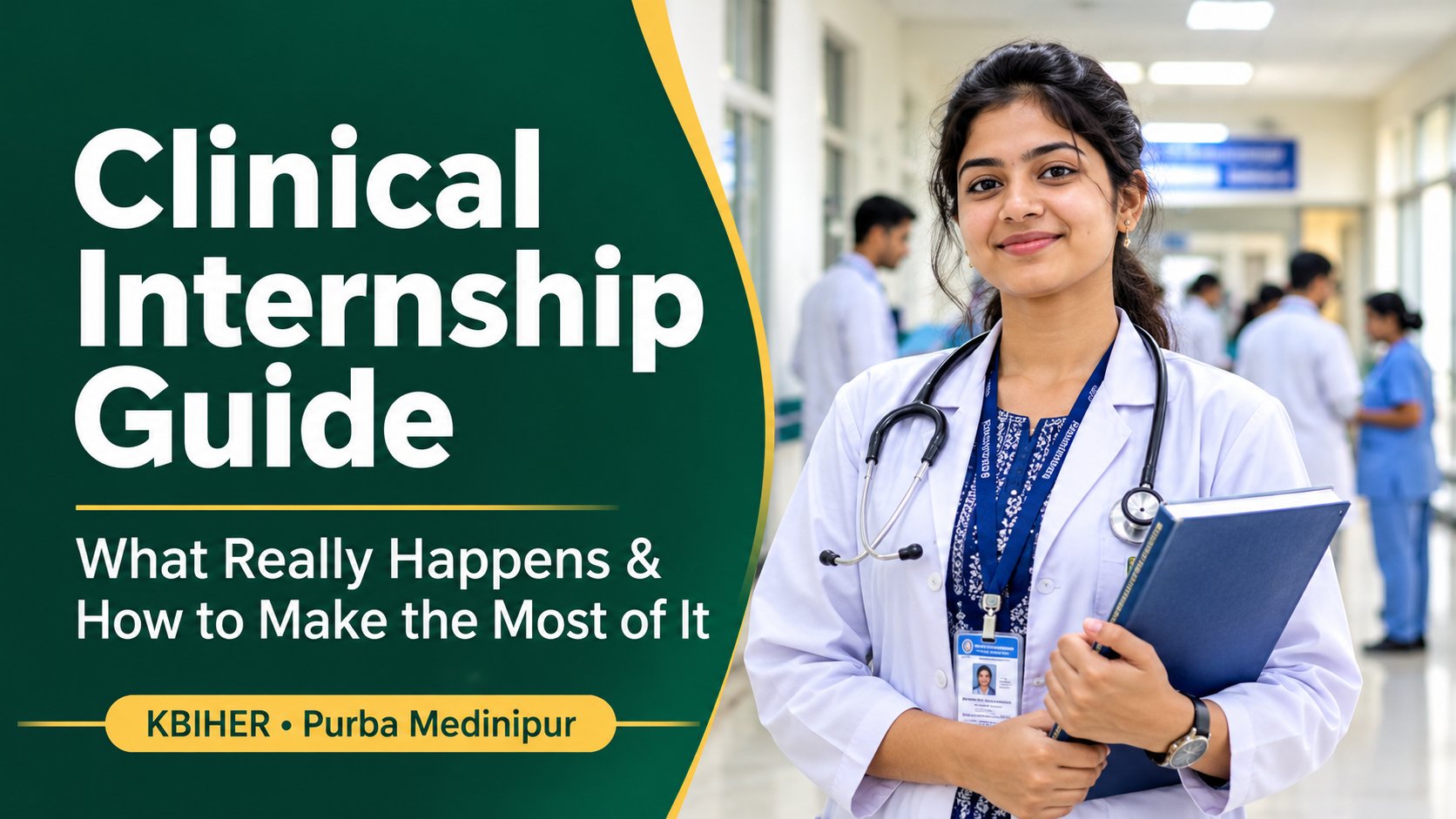
For most paramedical students, the day they first walk into a real hospital ward in uniform is the day the degree suddenly makes sense. Lectures, practicals and viva exams build the foundation, but it is the clinical internship that turns a student into a professional who can be trusted with a patient, a sample, a ventilator or an operation theatre.
Yet many students in West Bengal enter their internship with very little idea of what to expect. What will you actually do every day? Will you be allowed to touch patients? How are you assessed? And how can a few months of hospital training lead to your first job offer? This guide answers all of that — honestly and practically.
What Is a Clinical Internship in Allied Health Courses?
A clinical internship is the supervised, hands-on training period that is a mandatory part of every WBUHS-affiliated allied health degree. During this period you work inside a functioning hospital — in labs, wards, ICUs, emergency departments, operation theatres, physiotherapy units or hospital offices — under the guidance of qualified doctors, technologists and administrators.
It is not an observation tour. You are expected to perform real tasks, follow hospital protocols, maintain records and gradually take on more responsibility as your supervisors gain confidence in you. The exact duration and structure depend on your course and the university's current regulations, so always check the latest syllabus and your college's academic calendar.
What You Will Actually Do: Course-by-Course
Every programme has a different hospital "home". Here is what a typical internship looks like for each of the five programmes offered at KBIHER:
- B.Sc. Medical Laboratory Science (BMLS): Rotations through biochemistry, pathology, haematology, microbiology and blood bank sections. You will collect and process samples, run analysers, prepare slides, follow quality-control steps and learn how a report travels from the lab bench to the doctor.
- B.Sc. Emergency Medical Technology (BEMT): Time in the emergency department, ICU and critical care areas. You will assist with patient monitoring, triage support, airway and oxygen management, defibrillator readiness and safe patient transfer.
- B.Sc. Anaesthesia & Operation Theatre Technology (BAOTT): Work inside the OT complex — preparing theatres, checking anaesthesia machines, sterilising instruments, positioning patients and assisting the surgical and anaesthesia team before, during and after procedures.
- Bachelor of Physiotherapy (BPT): Postings in orthopaedic, neurological, cardio-respiratory and paediatric units, where you assess patients, plan exercise programmes and deliver therapy under a senior physiotherapist's supervision.
- Bachelor in Hospital Administration (BHA): Exposure to the front office, medical records, billing, HR, purchase and stores, quality and patient-relations departments — learning how a hospital actually runs behind the scenes.
A Typical Day as a Paramedical Intern
No two days are identical, but most interns follow a rhythm like this:
- Reporting and handover: Arrive before your shift, sign the attendance register and listen carefully to the handover from the previous team.
- Morning workload: This is usually the busiest time — sample collection, OT lists, ward rounds, OPD physiotherapy sessions or admission desks.
- Hands-on tasks under supervision: You perform procedures you have been trained for, while a senior watches, corrects and signs off.
- Documentation: Updating your logbook, case records and any department registers. In hospitals, if it is not documented, it did not happen.
- Learning moments: Short case discussions, demonstrations of new equipment or a quick doubt-clearing session with your supervisor.
Did you know? KBIHER students receive their clinical training through the college's clinical attachment with Tamralipto Government Medical College & Hospital, giving them exposure to the patient volume and case variety of a government teaching hospital.
How Interns Are Assessed
Your internship is not just about attendance. Most programmes evaluate interns through a combination of:
- Logbook or case record book — a detailed record of procedures observed, assisted and performed independently.
- Supervisor feedback on punctuality, skills, attitude, teamwork and patient handling.
- Attendance requirements set by the university — missing days can delay your completion certificate.
- Case presentations or viva where you explain cases you have handled and the reasoning behind each step.
Treat your logbook as your professional portfolio. A neat, complete logbook is something you can proudly show at a job interview.
7 Common Mistakes Interns Make (and How to Avoid Them)
- Staying silent when unsure. Asking "Sir/Ma'am, can you show me once more?" is professional. Guessing with a patient is not.
- Treating the internship as a formality. Seniors notice who disappears after attendance and who stays to help.
- Ignoring infection control. Hand hygiene, gloves, biomedical waste segregation and sharps disposal must become automatic.
- Using the phone in clinical areas. It distracts you and looks careless in front of patients and staff.
- Poor communication with patients. A simple introduction and explanation in Bengali, Hindi or English builds trust instantly.
- Leaving the logbook for the last week. Fill it daily while details are fresh and get signatures on time.
- Not building relationships. Technologists, nurses and doctors you meet now are your future references and colleagues.
How to Turn Your Internship into a Job Offer
Many allied health professionals get their first job through someone who saw them work as an intern. To make that happen for you:
- Be reliable: Show up on time, every time, and finish what you start.
- Master one or two skills deeply: Become the intern who is excellent at ECG, ABG sample handling, OT setup, gait training or patient registration.
- Learn the equipment: Ask about analysers, monitors, ventilators or HMIS software used in the department. Equipment familiarity is a strong hiring point.
- Keep a skills list: Note every procedure and machine you have worked on — it becomes the strongest section of your CV.
- Ask for feedback and a reference: Before you finish a posting, politely ask your supervisor what you can improve and whether they would recommend you.
- Use your college placement cell: Share your internship experience with your training and placement officer so they can match you with suitable openings.
A Short Checklist Before Your First Posting
- Clean uniform, ID card, closed shoes and a pocket notebook
- Logbook, pen and a small pocket guide for your subject
- Revision of basic life support, vital signs and infection-control steps
- Knowledge of your posting schedule, reporting time and supervisor's name
- A positive, humble attitude — the most valuable item on this list
Final Word
Your clinical internship is where confidence is built, skills are tested and careers quietly begin. Students who approach it with curiosity, discipline and respect for patients usually finish not just with a certificate, but with real competence and strong references.
If you want a paramedical degree where hospital exposure is part of the plan from the start, explore the WBUHS-affiliated programmes at Kshudiram Bose Institute of Health Education and Research (KBIHER), Purba Medinipur. Admissions for 2026–27 are open — call +91 7479034180 or apply online to speak with our admission team.
Ready to Begin Your Healthcare Career?
Applications for 2026–27 are open. Limited seats available at KBIHER, Medinipur.