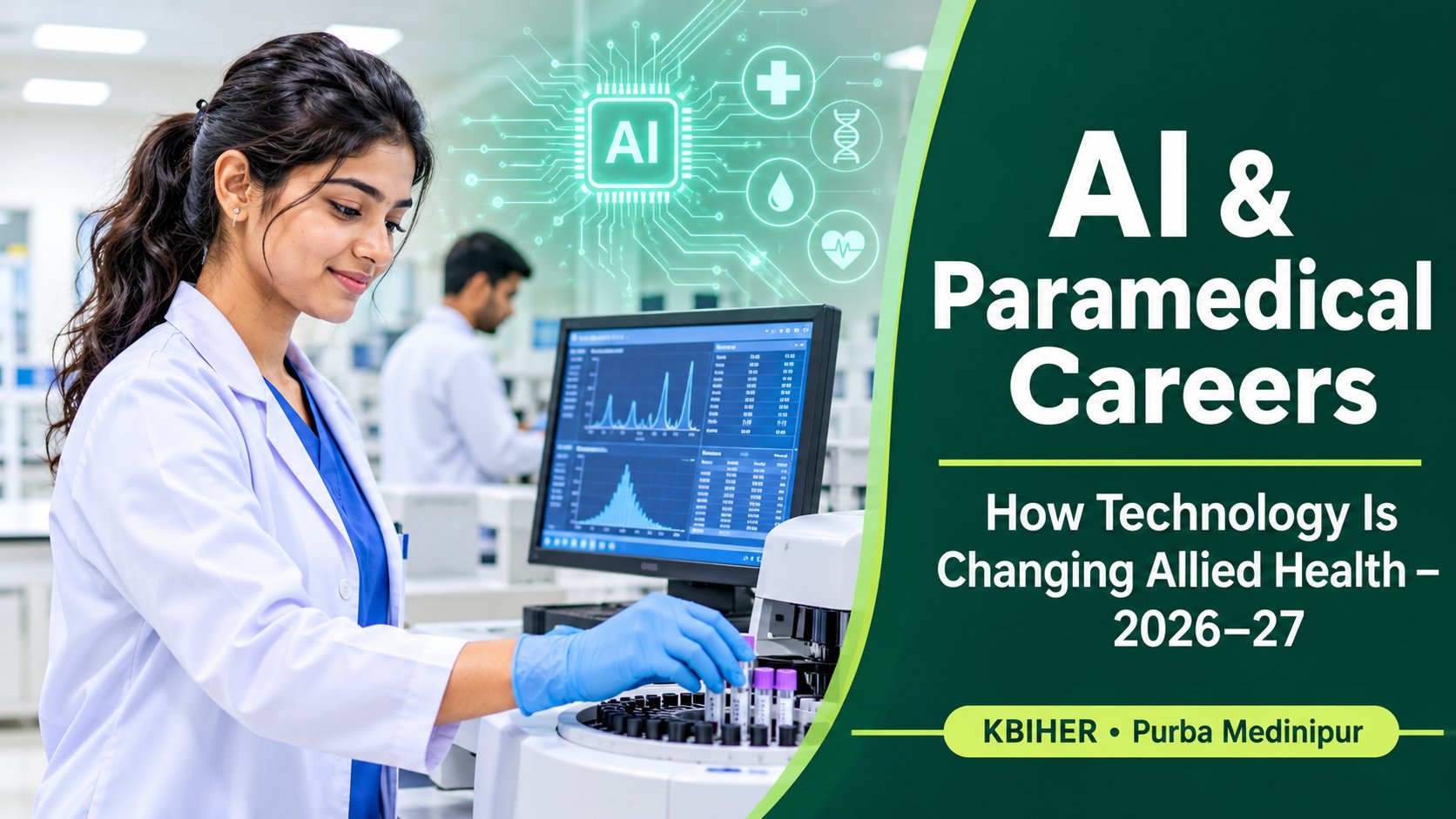
Automatic blood analysers that process hundreds of samples an hour. Digital X-rays that reach a doctor's phone in seconds. Hospital software that tracks every bed, bill and medicine. AI tools that flag an abnormal report before a human even opens it. Healthcare in India is changing fast — and many students and parents are asking a fair question: "Will technology and AI replace paramedical jobs?"
The short answer is no. But technology is clearly changing what allied health professionals do every day, and which skills employers value most. In this guide, we look at how each paramedical field is being reshaped and what you should learn during your degree to stay ahead.
Why Technology Is Creating More Demand, Not Less
Every new machine in a hospital needs trained people to operate it, calibrate it, maintain quality and interpret what it produces in the context of a real patient. Technology removes repetitive manual work, but it adds responsibility in areas like quality control, safety, data handling and patient communication.
- More diagnostics: Faster, cheaper tests mean more tests are ordered — and more trained lab and technical staff are needed.
- Growing private and government hospital networks: New hospitals, diagnostic chains and emergency services keep opening across tier-2 and tier-3 towns, including districts of West Bengal.
- Machines cannot replace the human touch: A ventilator cannot comfort a frightened patient, and software cannot decide how to safely position a patient on an OT table.
How Technology Is Changing Each Allied Health Field
1. Medical Laboratory Science (BMLS)
Modern labs use fully automated biochemistry and haematology analysers, barcoded sample tracking and Laboratory Information Systems (LIS). The lab scientist's role is shifting from manual testing towards quality control, machine calibration, result validation and troubleshooting. Molecular methods like PCR, which became widely known during COVID-19, are now common in larger labs.
2. Emergency Medical Technology (BEMT)
Today's emergency and critical care units rely on multi-parameter monitors, advanced ventilators, infusion pumps and point-of-care testing devices. Ambulances are increasingly GPS-tracked and connected to hospitals. Emergency technologists who understand device alarms, ventilator modes and rapid digital documentation are highly valued.
3. Anaesthesia & Operation Theatre Technology (BAOTT)
Operation theatres now feature modern anaesthesia workstations, laparoscopic and minimally invasive surgery towers, and in some advanced centres, robotic surgery systems. OT technologists must understand equipment setup, sterilisation standards and safety checks for increasingly sophisticated instruments.
4. Physiotherapy (BPT)
Physiotherapy is embracing electrotherapy devices, motion and gait analysis tools, wearable activity trackers and tele-rehabilitation, where patients follow guided exercise at home over video. Still, assessment, manual therapy and motivating patients through recovery remain deeply human skills.
5. Hospital Administration (BHA)
Hospitals run on Hospital Management Information Systems (HMIS), electronic medical records, digital billing and insurance processing. India's digital health initiatives, such as the Ayushman Bharat Digital Mission and the ABHA health ID, are pushing more hospitals towards digital records. BHA graduates who understand data, dashboards, health insurance processes and digital workflows stand out.
Key idea: AI is very good at spotting patterns. Allied health professionals are needed to make sure the input is right, the machine is working correctly, the output makes sense for that patient and the patient is cared for safely. That partnership is the future.
Will AI Replace Paramedical Jobs? Let's Be Realistic
Some routine tasks will certainly become automated — manual counting, paper registers and repetitive data entry are already disappearing. But the core of allied health work involves:
- Physical, hands-on patient care and procedures
- Judgement in unpredictable, emergency situations
- Responsibility, ethics and accountability for patient safety
- Communication with patients, families and the medical team
These are exactly the things machines struggle with. The professionals at risk are not those replaced by AI, but those who refuse to learn how to work alongside it.
8 Future-Ready Skills to Build During Your Degree
- Strong fundamentals: Anatomy, physiology and your core subject. Technology only helps people who understand what is happening inside the body.
- Equipment confidence: Learn the working principle, daily checks and common errors of every machine you meet in labs and postings.
- Basic computer skills: Typing, MS Excel, email and comfort with hospital software are now everyday requirements.
- Data accuracy: Correct patient identification, labelling and documentation — small errors become big problems in digital systems.
- Quality and safety standards: Get familiar with ideas like NABH and NABL accreditation, infection control and biomedical waste rules.
- Communication in multiple languages: Explaining procedures clearly in Bengali, Hindi and English remains irreplaceable.
- Critical thinking: Learn to question a result that does not match the patient's condition instead of trusting the screen blindly.
- A habit of continuous learning: Short online courses, workshops and seminars keep your knowledge current long after graduation.
How to Start Today as a Student
- Ask your lab instructors to explain how each analyser or device works, not just how to press the start button.
- During clinical postings, observe how the hospital records data — LIS, HMIS or electronic records — and ask to learn the basics.
- Attend the workshops and seminars your college organises; they often introduce newer techniques and equipment.
- Follow reliable sources such as university and government health portals to stay updated on regulations and digital health initiatives.
- Add every machine and software you have used to your CV. Employers look for this.
Final Word
Technology is not shrinking paramedical careers — it is upgrading them. The allied health professional of the next decade will be part caregiver, part technologist and part data-aware team member. Students who build strong fundamentals and stay curious about new tools will find themselves in demand across hospitals, diagnostic centres and emergency services.
At Kshudiram Bose Institute of Health Education and Research (KBIHER), Purba Medinipur, students train in modern laboratories and gain clinical exposure through our attachment with Tamralipto Government Medical College & Hospital across five WBUHS-affiliated programmes — BMLS, BEMT, BAOTT, BPT and BHA. Admissions for 2026–27 are open. Call +91 7479034180 or apply online to begin your future-ready healthcare career.
Ready to Begin Your Healthcare Career?
Applications for 2026–27 are open. Limited seats available at KBIHER, Medinipur.