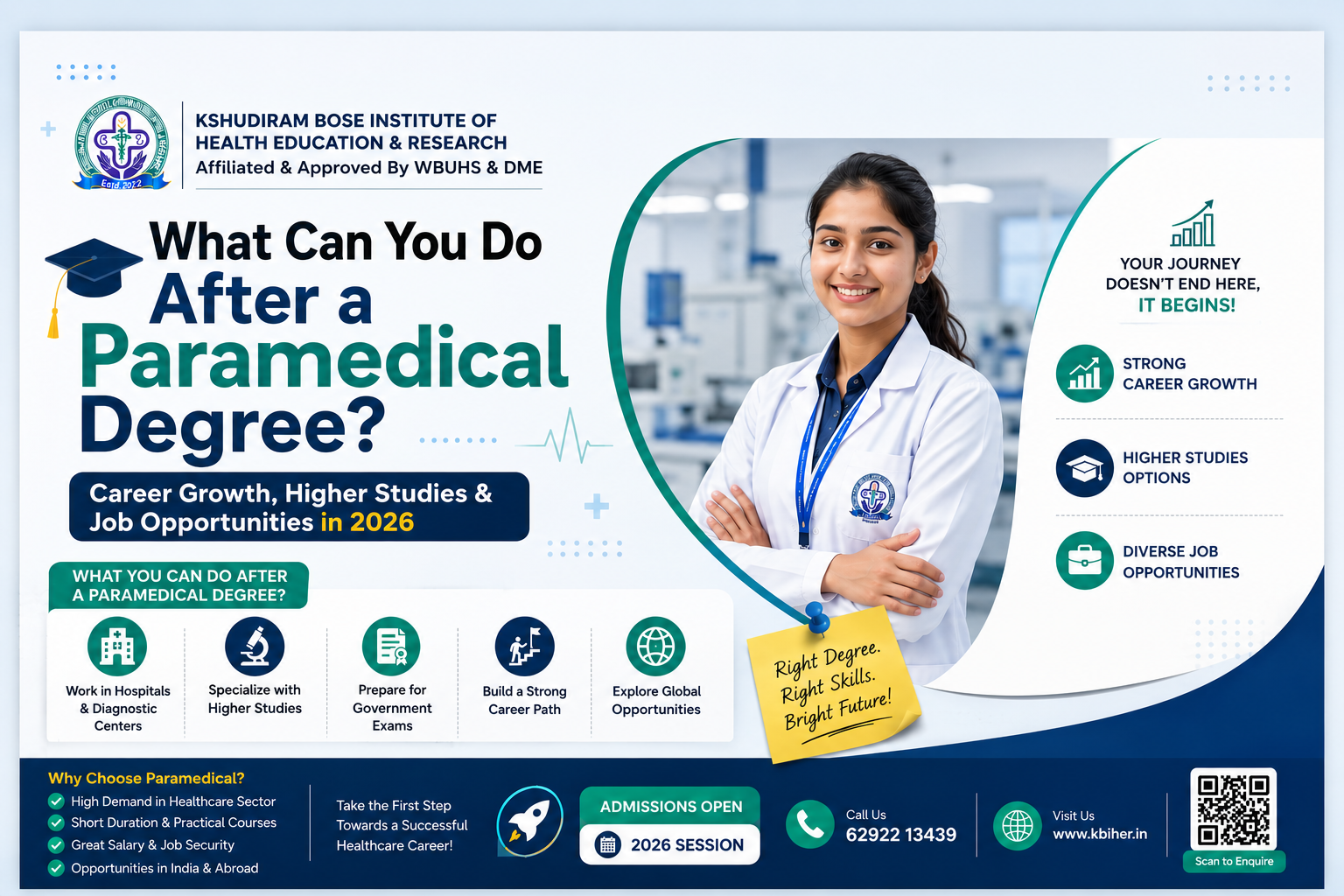
Before enrolling in any course, every student and parent asks the same important question: "Where will this degree take me in five or ten years?" It's a fair question — a career isn't just about your first job, it's about the growth, stability, and opportunities that follow.
The good news is that a paramedical degree is not a dead-end qualification. It's a launchpad. From your first role in a hospital to senior specialist positions, higher studies, government jobs, and even careers abroad, the paths open to paramedical graduates are wide and rewarding.
In this guide, we'll map out exactly what your future can look like after a paramedical degree — and how Kshudiram Bose Institute of Health Education and Research (KBIHER), Purba Medinipur, sets you up for long-term success from day one.
Is Paramedical a Good Long-Term Career?
Absolutely — and the reasons are structural, not temporary. Healthcare is one of the few sectors that keeps growing regardless of the economy, because people always need medical care.
Here's what makes paramedical careers stable and future-proof:
- Constant demand across government and private hospitals, diagnostic chains, and clinics
- An aging population and rising lifestyle diseases increasing the need for care
- Rapid expansion of healthcare infrastructure across West Bengal and India
- Roles that cannot be easily automated because they require human skill and judgement
- Clear paths to promotion, specialization, and higher earnings
In short, a paramedical career offers something rare — job security combined with genuine room to grow.
Career Growth Within Your Field
Your first job is just the beginning. In most paramedical careers, you move steadily upward as you gain experience, skill, and reputation.
A typical growth journey looks like this:
- Entry level: Technologist, technician, assistant, or junior executive roles where you build hands-on experience.
- Mid level (3–5 years): Senior technologist, shift in-charge, or department coordinator with more responsibility and higher pay.
- Senior level: Department head, chief technologist, or specialist roles leading teams and managing operations.
- Leadership: Administrative, training, or consulting positions, and even independent practice in fields like physiotherapy.
As you climb, your salary rises significantly — experienced specialists and administrators often earn several times their entry-level pay at top hospitals.
Higher Studies After a Paramedical Degree
If you want to accelerate your career or specialize, higher education opens powerful doors. After completing your bachelor's degree at KBIHER, you can pursue advanced qualifications such as:
- Master's degrees (M.Sc.) in your specialization — for example, M.Sc. in Critical Care, Medical Laboratory Technology, or Operation Theatre Technology.
- MBA in Hospital Management or MHA (Master of Hospital Administration) for those moving into leadership and management.
- Specialized certifications in areas like dialysis technology, cardiac care, laparoscopic and robotic surgery support, or healthcare quality and IT.
- Master of Physiotherapy (MPT) with specializations in orthopaedics, neurology, sports, or cardiopulmonary rehabilitation.
Higher studies not only increase your earning potential — they also open teaching, research, and senior leadership roles across the healthcare sector.
Government Job Opportunities
Many students dream of a stable, respected government job — and a paramedical degree makes you eligible for a wide range of them. Government roles typically offer job security, structured pay scales, and strong benefits.
Paramedical graduates can explore opportunities in:
- Government hospitals and medical colleges under state health departments
- Central government health institutions and public health programs
- Recruitment through state and national health recruitment boards
- Employees' State Insurance (ESIC) hospitals and dispensaries
- Railways, defence medical services, and other public-sector health units
- Public health missions and community healthcare initiatives
Because KBIHER programs are WBUHS-affiliated and DME-approved, your degree meets the eligibility standards required for these government pathways. Always check the specific eligibility criteria in each official recruitment notification before applying.
Opportunities to Work Abroad
Trained paramedical professionals are in demand worldwide, and many Indian graduates build rewarding international careers. Countries across the Gulf, and regions such as the UK, Australia, and beyond, actively recruit skilled healthcare technologists, physiotherapists, and administrators.
Keep in mind that working abroad usually requires:
- Relevant licensing or registration exams for the destination country
- English-language proficiency tests where applicable
- Verified degrees and clinical experience
A strong foundation — real clinical training, recognized qualifications, and hands-on experience — makes these international pathways far more achievable. That's exactly the foundation KBIHER is built to provide.
Career Outlook by Program
Each KBIHER program leads to its own promising trajectory:
- BMLT (Medical Laboratory Technology): Grow from lab technologist to lab in-charge, quality manager, or roles in research and diagnostics.
- BEMT (Emergency Medical Technology): Advance from ICU/CCU technologist to critical-care specialist or emergency services coordinator.
- BAOTT (Anaesthesia & OT Technology): Progress from OT technologist to senior surgical support specialist or OT administrator.
- BPT (Physiotherapy): Build a career as a clinical or sports physiotherapist, or open your own independent practice.
- BHA (Hospital Administration): Move from operations executive to hospital administrator, consultant, or senior healthcare manager.
How KBIHER Prepares You for Long-Term Success
A degree alone doesn't build a career — the quality of your training does. Here's how KBIHER gives you a lasting advantage:
- ✅ Affiliated with West Bengal University of Health Sciences (WBUHS)
- ✅ Approved by the Directorate of Medical Education (DME), Govt. of West Bengal
- ✅ Real clinical training at Tamralipto Government Medical College & Hospital
- ✅ Hands-on exposure to actual patients, equipment, and medical teams
- ✅ 90%+ placement rate at leading hospitals across India
- ✅ 30+ experienced faculty guiding your academic and professional growth
- ✅ Modern labs, simulation rooms, and a digital library
- ✅ Affordable fees with scholarships and installment options
Because your training is rooted in a real government hospital, you graduate not just qualified — but confident, experienced, and ready to grow.
Where KBIHER Graduates Work
Our dedicated placement cell connects students with top healthcare organizations, including:
- Apollo Hospitals
- Fortis Healthcare
- Narayana Health
- AMRI Hospitals
- Medica Superspecialty Hospital
- Manipal Hospitals
- Max Healthcare
- Tata Medical Center
- SSKM & NRS Medical College
- Tamralipto Government Medical College
Graduates also build careers in government hospitals, diagnostic centres, emergency services, and healthcare companies.
What Our Students Say
"Joining KBIHER was the best decision of my life. The faculty are extremely supportive and the laboratory sessions are exceptional." — Sum Bahadur Rai, BMLT Student
"The supportive environment and excellent faculty have made me confident and career-ready." — Sanjukta Roy, BHA Student
"KBIHER has world-class labs and dedicated teachers. The clinical posting gave me real patient exposure that no classroom can replicate." — Avisek Dash, BMLT Student
Admission Details for 2026–27
Your long-term career starts with the right first step. Here's how to begin.
ELIGIBILITY:
- For BMLT, BEMT, BAOTT & BPT: 10+2 (Science) with Physics, Chemistry, and Biology
- For BHA: 10+2 in any stream (Science/Commerce/Arts preferred)
- Merit-based selection as per WBUHS guidelines
SEATS: Limited intake per program — apply early to secure your place.
APPLICATION PROCESS:
- Submit your online application at www.kbiher.in
- Complete document verification (marksheets, certificates, ID proof)
- Merit-based shortlisting
- Attend counseling and confirm your seat
CONTACT:
- 📞 Call: +91 7479034180
- 🌐 Website: www.kbiher.in
- 📍 Campus: Tajpur, Mahishadal, Purba Medinipur – 721628, West Bengal
Conclusion
A paramedical degree is far more than a qualification — it's the beginning of a career with genuine security, steady growth, and opportunities that can take you from a local hospital to leadership roles, higher studies, government service, or even careers abroad.
The key is starting with the right training. At KBIHER, real government-hospital experience, expert faculty, and strong placement support give you a foundation that keeps paying off for years.
Admissions for 2026–27 are now open, and seats are limited across all programs.
🎯 Apply online at www.kbiher.in
📞 Call: +91 7479034180
📍 Visit: Tajpur, Mahishadal, Purba Medinipur – 721628
Ready to Begin Your Healthcare Career?
Applications for 2026–27 are open. Limited seats available at KBIHER, Medinipur.