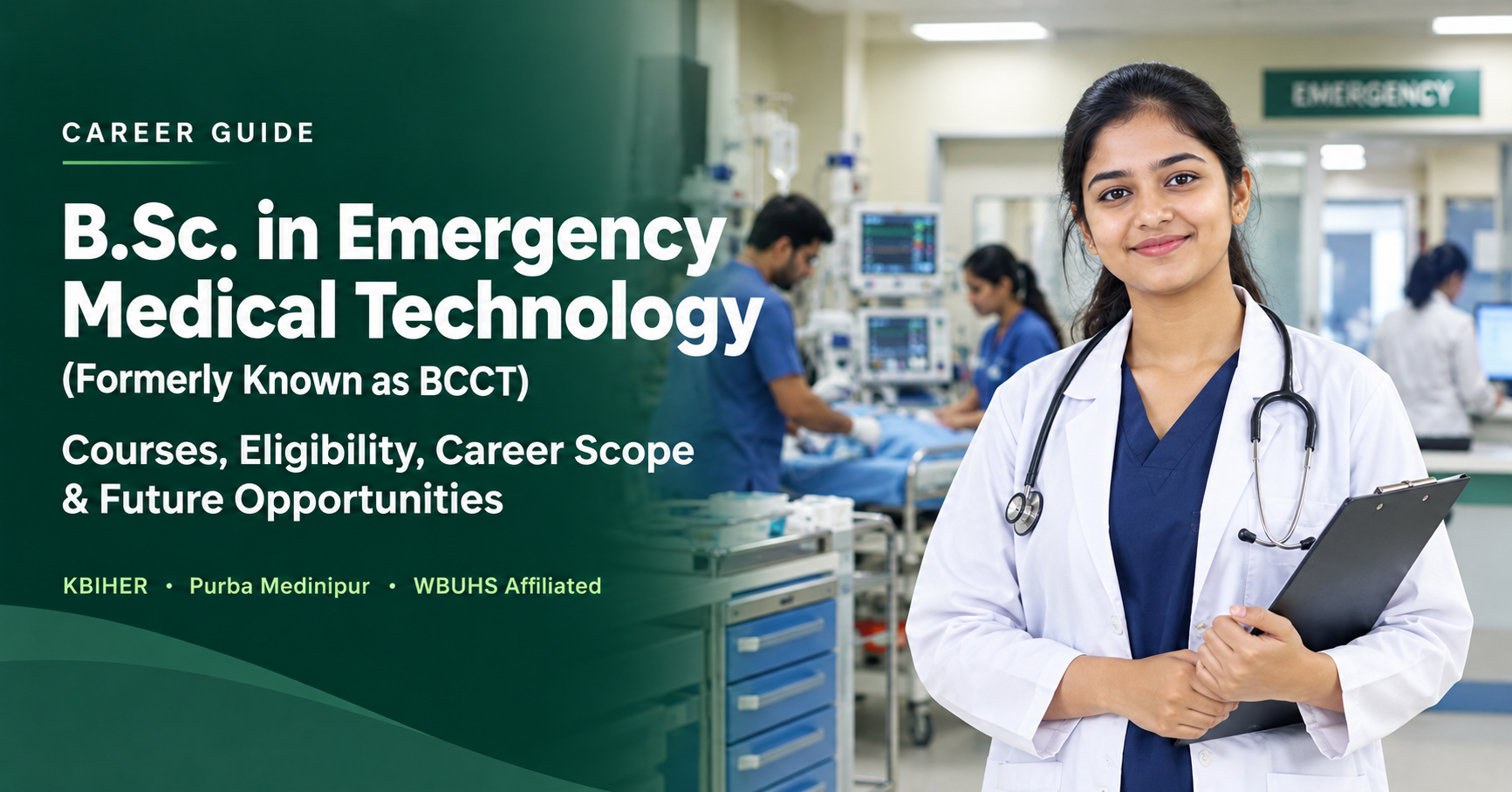
Emergency situations demand quick decisions, coordinated teamwork and trained healthcare professionals. When a patient arrives at a hospital with a serious injury, sudden illness or critical condition, every moment matters. Behind the doctors and nurses working at the front line is a wider team of trained professionals who help emergency care function smoothly.
The B.Sc. in Emergency Medical Technology, formerly known as BCCT, is an undergraduate allied healthcare program designed for students who are interested in emergency and critical-care environments. The course introduces students to emergency procedures, patient care, medical equipment and the practical responsibilities involved in supporting healthcare teams.
What Is B.Sc. in Emergency Medical Technology?
B.Sc. in Emergency Medical Technology focuses on the knowledge and practical skills required to work in emergency and critical healthcare settings. Students learn how emergency departments operate and how healthcare professionals work together when patients require immediate attention.
The field combines medical knowledge, practical training, patient handling, equipment management and teamwork. Students are prepared to assist healthcare professionals and contribute to emergency-care services within their defined professional responsibilities.
Unlike a routine hospital environment, emergency care can involve rapidly changing situations. This makes observation, communication, discipline and the ability to follow established procedures particularly important.
Why Choose Emergency Medical Technology?
For students interested in healthcare but looking for a specialised allied health profession, Emergency Medical Technology can provide exposure to one of the most dynamic areas of a hospital.
The course may be suitable for students who enjoy practical learning, are interested in medical equipment and procedures, and want to work as part of a multidisciplinary healthcare team.
It can also be an interesting choice for students who want their professional environment to involve emergency care, critical situations and direct interaction with healthcare teams.
What Do You Study in This Course?
The exact curriculum may vary according to the university and institution, but students generally develop knowledge across fundamental medical sciences, emergency care and practical healthcare procedures.
Areas of learning may include:
- Human Anatomy and Physiology
- Fundamentals of Emergency Medical Care
- Patient Assessment and Monitoring
- Emergency Procedures
- Trauma and Injury Management
- Critical Care Concepts
- Emergency Medical Equipment
- Patient Handling and Transportation
- Infection Prevention and Control
- Medical Terminology
- Healthcare Communication
- Professional Ethics and Patient Safety
The objective is to help students understand both the clinical environment and the role of an emergency medical technology professional within a healthcare team.
Why Practical Training Matters
Emergency healthcare cannot be learned entirely from textbooks. Students need to understand how medical equipment, emergency procedures and healthcare teams function in real-world environments.
When choosing a college, students should therefore ask important questions about practical and clinical exposure. Find out where students receive their training, when practical exposure begins, which departments they visit and what equipment they get an opportunity to understand.
A strong combination of classroom learning and supervised practical exposure can help students become more familiar with the professional environment they may encounter after graduation.
Career Opportunities After B.Sc. in Emergency Medical Technology
After completing the degree, graduates can explore opportunities related to emergency care, critical care and hospital-based healthcare services, depending on their qualification, experience and the requirements of individual employers.
Potential work environments may include:
- Hospital Emergency Departments
- Critical Care Units
- Trauma Care Facilities
- Emergency Medical Services
- Ambulance Services
- Healthcare Centres
- Specialised Emergency Care Facilities
- Other Hospital-Based Healthcare Services
Depending on the role, professionals may assist with emergency procedures, prepare equipment, support patient monitoring, help with patient transportation and work alongside doctors, nurses and other healthcare professionals.
What Does an Emergency Medical Technologist Do?
An Emergency Medical Technologist works as part of a healthcare team. The exact responsibilities depend on the workplace, position, training and applicable professional requirements.
Responsibilities may include:
- Preparing emergency equipment and supplies.
- Supporting healthcare professionals during emergency procedures.
- Monitoring patients and reporting relevant observations.
- Assisting with safe patient movement and transportation.
- Maintaining emergency-care equipment and supplies.
- Following infection-control and patient-safety procedures.
- Supporting smooth operations within emergency-care areas.
Skills You Need for Emergency Medical Technology
Working in emergency healthcare requires more than academic knowledge. Professionals need to combine technical understanding with communication, teamwork and discipline.
Quick Thinking
Emergency environments can change rapidly. Professionals need to stay attentive and follow established procedures appropriately.
Teamwork
Emergency care involves multiple professionals working together. Effective coordination and communication are essential.
Communication
Clear communication helps healthcare teams coordinate patient care and respond effectively to changing situations.
Attention to Detail
Emergency procedures often involve protocols, equipment and patient information where accuracy and attention to detail are important.
Professional Discipline
Healthcare environments require professionals to follow safety procedures, maintain professional conduct and respect patient privacy and dignity.
Is Emergency Medical Technology Only About Ambulances?
Myth: Emergency Medical Technology is only about working in an ambulance.
Reality: Emergency healthcare extends beyond ambulance services. Depending on their qualification and role, professionals can work in hospital emergency departments, trauma-care environments, critical-care settings and other emergency healthcare services.
Ambulance and pre-hospital emergency care can be one area of work, but emergency medical technology also has applications within hospital-based healthcare.
Is This a Doctor's Course?
No. B.Sc. in Emergency Medical Technology is an allied healthcare program. It prepares students for a professional role within the healthcare team.
Emergency Medical Technologists do not replace doctors or nurses. Instead, they support healthcare professionals and contribute to emergency and critical-care services within their defined scope of practice.
Who Can Apply?
Eligibility requirements can vary depending on the institution, university and academic session. Students should check the latest admission requirements before applying.
Applicants should verify the required subjects, minimum marks, documentation and other admission conditions directly with the institution for the relevant academic year.
What Should You Check Before Choosing a College?
Choosing an allied healthcare college is an important decision. Students should look beyond the course name and understand the actual learning environment.
- Verify the university affiliation.
- Check applicable recognition and approvals.
- Ask where clinical training takes place.
- Understand the practical training structure.
- Check the available medical equipment and facilities.
- Learn about the faculty and their professional experience.
- Ask for the complete course fee structure.
- Understand available career guidance and placement support.
Higher Studies After B.Sc. in Emergency Medical Technology
A bachelor's degree can also serve as a foundation for further academic and professional development. Depending on eligibility, graduates may explore postgraduate programs and advanced training related to emergency care, critical care, healthcare management, public health and other allied healthcare fields.
Students should always check the eligibility requirements of the specific postgraduate program before applying.
Frequently Asked Questions
What is BCCT?
BCCT is the former name associated with the program that is now presented as B.Sc. in Emergency Medical Technology. Students should refer to the current official program and admission documents for the latest nomenclature and course details.
Is Emergency Medical Technology a paramedical course?
Emergency Medical Technology belongs to the broader allied healthcare education field. The exact terminology and classification may depend on the institution and applicable regulatory framework.
Where can Emergency Medical Technology graduates work?
Graduates can explore opportunities in hospital emergency departments, critical-care environments, trauma-care facilities, ambulance and emergency medical services and other relevant healthcare settings, subject to qualification and employer requirements.
Does the course include practical training?
Practical and clinical exposure is an important part of preparing for emergency healthcare environments. Students should confirm the specific practical-training structure of their chosen institution before admission.
Can I pursue higher studies after this degree?
Yes. Graduates can explore relevant postgraduate education and advanced professional training, depending on the eligibility requirements of the chosen program.
Prepare for a Career Where Every Second Matters
Emergency healthcare requires trained people who can work with discipline, communicate effectively and support medical teams in demanding situations. A career in Emergency Medical Technology can give students the opportunity to become part of this essential healthcare environment.
If you are interested in healthcare, practical learning and emergency-care services, the B.Sc. in Emergency Medical Technology (Formerly Known as BCCT) is a field worth exploring.
Before choosing your college, verify the program details, affiliation, practical exposure, facilities, fees and current eligibility requirements. Understanding the course before admission is the first step towards making an informed career decision.
Explore Emergency Medical Technology at KBIHER
Kshudiram Bose Institute of Health Education & Research (KBIHER) offers healthcare education programs for students interested in building professional careers in the health sector.
Students and parents are encouraged to visit the campus, understand the program, ask about practical training and verify the latest admission requirements before applying.
Admissions: 2026–27
Website: www.kbiher.in
Call / WhatsApp: +91 7479034180 | +91 7479034181
Email: kbiher2022@gmail.com
Campus: Tajpur, Mahishadal, Purba Medinipur – 721628, West Bengal
Ready to Begin Your Healthcare Career?
Applications for 2026–27 are open. Limited seats available at KBIHER, Medinipur.