There is a particular conversation that happens at every family gathering in West Bengal after the Higher Secondary results come out. A student says they are considering a paramedical course. And somebody — an uncle, a neighbour, a well-meaning family friend — says something that is completely, confidently wrong.
"That's just a technician's job." "There's no future in it." "Only students who couldn't do better take those courses."
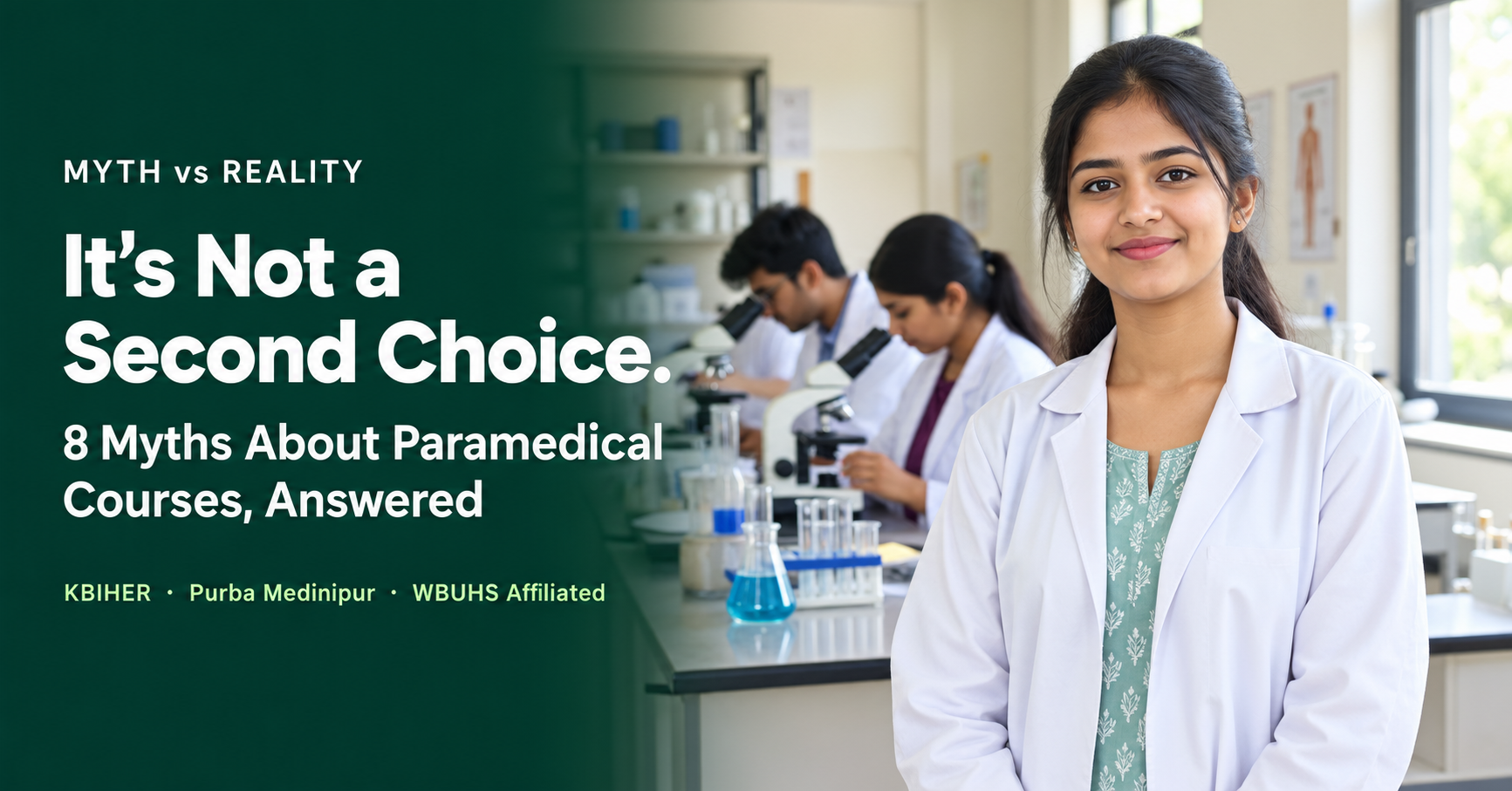
These claims get repeated so often that they start to sound like facts. They are not. This article takes the eight most common myths about allied health education in West Bengal and sets each one against what is actually true — so students and parents can make a decision based on reality rather than rumour.
Myth 1: "Paramedical is only for students who failed to get into MBBS"
The reality: These are different professions requiring different aptitudes, not a first choice and a consolation prize.
A medical laboratory scientist who can identify an abnormal cell on a blood smear is doing skilled diagnostic work that a physician depends on entirely. An OT technologist who catches a sterility breach prevents an infection that could cost a life. An emergency care specialist managing a ventilator is doing something no doctor can do alone in a crisis.
Plenty of students choose these fields deliberately — because they want hands-on clinical work, a shorter route into the workforce, or a specialisation that genuinely interests them more than general medicine. A NEET rank measures performance on one examination. It does not measure whether you belong in healthcare.
Myth 2: "There are no government jobs for paramedical graduates"
The reality: Government health systems are among the largest employers of allied health professionals in the country.
Recruitment happens through defined channels that publish notifications periodically:
- State health recruitment boards and the Department of Health & Family Welfare, for posts across district hospitals, medical colleges and health centres
- Central institutions including AIIMS hospitals, PGIMER and ESIC facilities
- Railway health units and armed forces medical establishments
- National health mission programmes and municipal health departments
There is one condition, and it is the condition that actually matters: your degree must be from a recognised institution. Notifications specify eligibility precisely, and an unrecognised qualification can leave you unable to even submit an application.
Myth 3: "A paramedical degree from a private college isn't valid"
The reality: What determines validity is affiliation and approval, not whether the college is government or private.
A degree is valid when the institution is affiliated with a recognised university and holds approval from the relevant authority. For allied health programs in West Bengal, that means checking two things:
- University affiliation: Is the college affiliated with the West Bengal University of Health Sciences (WBUHS) or another recognised university? The degree is awarded by the university, not the college.
- Government approval: Does it hold approval from the Directorate of Medical Education (DME), Government of West Bengal?
What you should actually do: ask any college you are considering to state its affiliation and approval in writing, then verify it independently on the university and DME websites. A legitimate institution will welcome the question. Evasiveness is your answer. KBIHER's programs are WBUHS-affiliated and DME-approved.
Myth 4: "The salary is very low"
The reality: Starting salaries are modest, as they are in almost every profession. What people get wrong is assuming the starting figure is the ceiling.
Earnings in allied health rise with three things — specialisation, experience and institution type. A general lab technologist and a molecular diagnostics specialist are in very different brackets. So are a general OT technologist and one trained for cardiac theatres. So are a fresh physiotherapist and one running an established clinic after eight years.
Compare honestly: against a four-year professional degree in many other fields, allied health offers faster entry into paid work, a clear specialisation ladder, and demand that does not evaporate in a downturn. People fall ill regardless of the economy.
Myth 5: "You can't study further after a paramedical degree"
The reality: The postgraduate pathways are well established and widely available.
- M.Sc. in your specialisation — laboratory technology, critical care, operation theatre technology, molecular diagnostics and more
- MPT for physiotherapy graduates, with specialisations in orthopaedics, neurology, cardiopulmonary and sports
- MHA or MBA in Hospital Management, the standard route into senior administration
- Master of Public Health, leading into health policy, NGOs and international organisations
- Ph.D. and research careers, plus teaching positions in allied health institutions
Myth 6: "These courses are all theory with no real training"
The reality: This one is not entirely a myth — it is true of some colleges, which is exactly why it circulates.
There genuinely are institutions where students see a hospital only in the final year, where "labs" contain equipment that no longer works, and where clinical attachment exists only on the brochure. Graduates from those colleges struggle, and their experience becomes everyone else's cautionary tale.
The fix is not to avoid the field. It is to interrogate the training before you enrol:
- Which hospital handles the clinical training, and is it a high-volume government or reputed institution?
- From which semester does hospital exposure begin?
- Which departments will students rotate through?
- Can you see the laboratories and simulation rooms during a campus visit?
At KBIHER, clinical training runs through Tamralipto Government Medical College & Hospital, with exposure beginning in the early semesters across ICU, operation theatre, emergency, laboratory and physiotherapy departments.
Myth 7: "There's no scope outside India"
The reality: Allied health skills are portable, and international recruitment of laboratory technologists, OT and ICU technicians and physiotherapists is active across the Gulf, the UK, Australia, New Zealand and Canada.
What is true is that it is not automatic. Every destination has its own licensing authority and evaluation process, most require documented clinical experience first, and English language testing is standard. Requirements also change, so current rules must be checked on the official regulator's website of the country concerned.
The practical implication is the same as everywhere else in this article: your degree must be from a properly affiliated university, because foreign authorities verify credentials at source.
Myth 8: "Girls shouldn't take courses with hospital shift duties"
The reality: Women make up a very large share of India's healthcare workforce, across laboratories, operation theatres, ICUs, physiotherapy departments and hospital administration.
Hospitals are structured, supervised, institutional workplaces with defined protocols. Concerns about safety and accommodation are reasonable and should be asked about directly — hostel facilities, campus security, supervision during clinical postings — rather than used as a reason to close off a career entirely.
If the worry is about the daughter, the productive question is "what arrangements does the college have?" not "should she do this at all?"
What Parents Should Actually Worry About
The myths above are noise. Here are the four concerns genuinely worth acting on:
- Verify affiliation and approval independently. Not from the brochure — from the university and DME websites.
- Confirm the clinical training hospital by name. A vague answer here is the single biggest red flag in this sector.
- Get the complete fee structure in writing for the full program duration, not just year one.
- Visit the campus and talk to current students without the admission staff present. Five minutes of that is worth fifty pages of marketing.
Frequently Asked Questions
Is NEET required for paramedical courses?
No. Admission to allied health degree programs at KBIHER is merit-based on 10+2 marks, with document verification and counselling. Confirm the current process for the session with the admission office.
Which course should I pick if I'm unsure?
Choose by how you prefer to work — near patients under pressure, with samples and precision, or with systems and people — rather than by which title sounds most impressive to relatives.
Can a commerce or arts student apply?
Yes, for Bachelor in Hospital Administration, which is open to all streams. The clinical programs require Physics, Chemistry and Biology at 10+2 level.
Decide on Facts, Not on What the Neighbour Said
Every hospital you have ever visited ran on the work of allied health professionals. Somebody processed the test. Somebody prepared the theatre. Somebody monitored the patient through the night. That work is skilled, regulated, permanent and needed — in Purba Medinipur as much as in Kolkata or Dubai.
Come and see it for yourself. Visit the campus, meet the faculty, look at the laboratories, and ask every difficult question on this page. Admissions for the 2026–27 session are open across all five programs.
Visit the Campus · Ask Anything · Admissions 2026–27
- Website: www.kbiher.in
- Call / WhatsApp: +91 7479034180 | +91 7479034181
- Email: kbiher2022@gmail.com
- Campus: Tajpur, Mahishadal, Purba Medinipur – 721628, West Bengal
Recruitment norms, registration requirements and overseas licensing rules are revised periodically; please verify current criteria with the relevant official authority. See also the Academic Programme, Placement and Admissions pages on the KBIHER website.
Ready to Begin Your Healthcare Career?
Applications for 2026–27 are open. Limited seats available at KBIHER, Medinipur.