
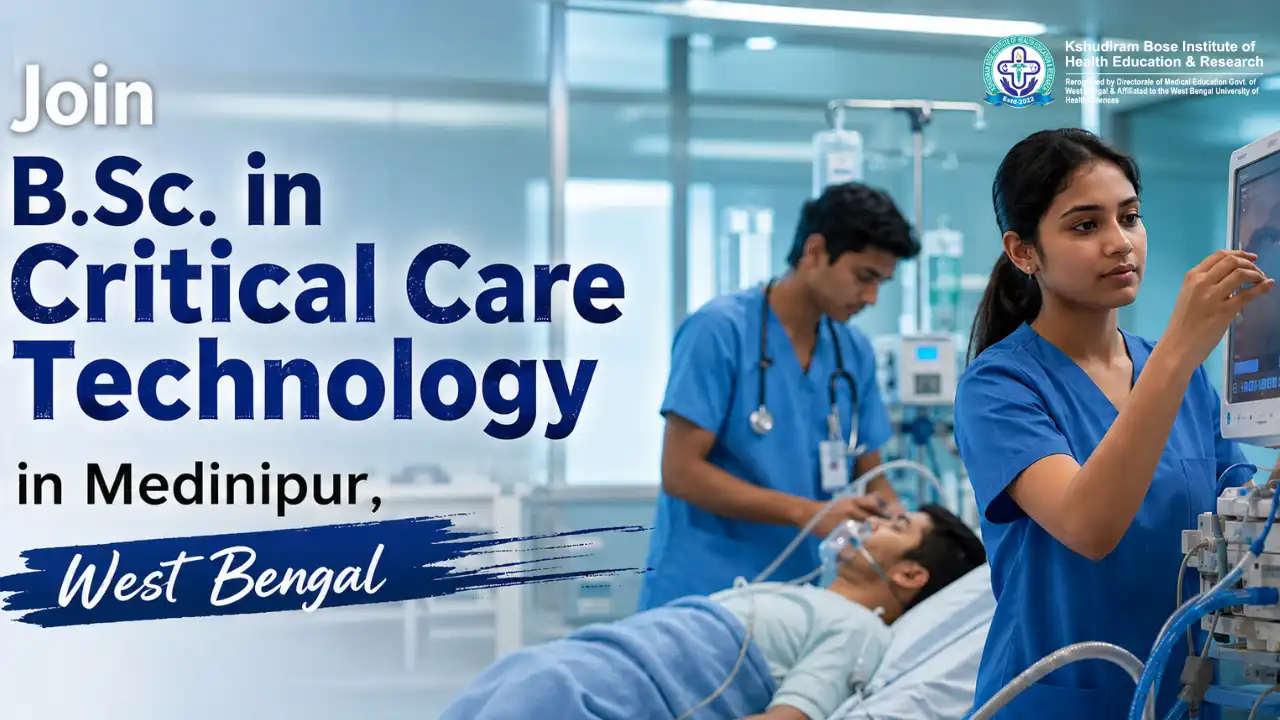
Every emergency ward tells a story of lives saved in the nick of time. Behind every story is a Critical Care Technologist - the trained professional who manages life-support equipment, monitors vital signs, and assists physicians when every second matters. If you have ever felt a calling to be that person, then this guide is written for you. At KBIHER , we offer the B.Sc. In Critical Care Technology In Medinipur West Bengal - a four-year undergraduate programmed that combines deep clinical knowledge with hands-on technical training, preparing you to step confidently into the high-pressure environments of modern healthcare.
This guide covers everything you need to know: what the programmed is, who it is for, what you will study, what career paths it unlocks, and how to secure your seat at KBIHER. Whether you are a student fresh out of Class 12 or a parent trying to understand this field, read on - we have kept nothing back.
Critical care, in medical terms, refers to the management of life-threatening conditions that require constant, sophisticated monitoring. Think of a patient on a ventilator after major surgery, a trauma victim in the ICU, or a cardiac patient requiring continuous hemodynamic monitoring. These patients need more than just doctors and nurses - they need specially trained technologists who understand the machines keeping them alive.
A Critical Care Technologist is responsible for operating, calibrating, and maintaining equipment such as ventilators, defibrillators, infusion pumps, cardiac monitors, and arterial blood gas analyses. They work side by side with intensivists and critical care nurses, often being the first to detect a machine alarm or a shift in a patient's vitals. The role is demanding, intellectually stimulating, and deeply meaningful.
India's healthcare sector is growing at an extraordinary pace. Hospitals in tier-2 and tier-3 cities are establishing dedicated ICUs and trauma centers, and the demand for qualified critical care professionals is far outpacing supply. Choosing this career today means entering a field where your skills will always be needed.
KBIHER has been shaping healthcare professionals in Medinipur, West Bengal, for years. We are not a factory that processes students - we are a community that nurtures them. Every student who walks through our doors is treated as a future professional, not just a roll number.
Our faculty includes experienced clinicians and academicians who have worked in high-acuity care settings. The institute is affiliated with a recognized university and operates in strict compliance with regulatory guidelines. Our simulation labs are equipped with industry-relevant equipment so that when our graduates step into a real ICU for the first time, nothing feels entirely unfamiliar.
Located in Medinipur, West Bengal, KBIHER offers the advantage of a peaceful academic environment away from the chaos of metro cities, while maintaining strong clinical tie-ups with hospitals that give students real-world exposure. Our campus is accessible, affordable to live around, and supported by a warm, tight-knit student community. Many of our alumni speak about the personalized mentorship they received here as the foundation of their professional confidence.
The first year lays the groundwork with subjects such as Human Anatomy and Physiology, Biochemistry, Microbiology, and Fundamentals of Critical Care. Understanding how the human body works at a cellular level is essential before you can appreciate why it breaks down under critical illness.
In the second year, the focus shifts to clinical sciences - Pathophysiology, Pharmacology, and an introduction to Critical Care Equipment and Technology. Students begin to understand how diseases unfold in the body and how medical devices intervene in that process. This is also when clinical observation visits to partner hospitals begin in earnest.
The third year is where the programmed truly comes alive. Students study Advanced Ventilator Management, Cardiac Monitoring and Interpretation, Haemodynamic Monitoring, Renal Replacement Therapy, and Nutritional Support in Critical Care. Practical sessions in our simulation lab increase significantly, and students spend structured time in hospital ICUs under the supervision of senior faculty.
The fourth year is dominated by clinical internship and project work. Students are placed in affiliated hospitals where they function as junior Critical Care Technologists under supervision. By the time they graduate, they have managed real patients, real equipment, and real emergencies - under the safety net of experienced mentors.
To apply for the B.Sc. in Critical Care Technology at KBIHER, a candidate must have passed Class 12 (10+2) or an equivalent examination from a recognized board. The stream must include Physics, Chemistry, and Biology (PCB) as core subjects. A minimum aggregate of 45% marks in PCB is required for general category candidates; reserved category candidates may be eligible with slightly lower marks as per applicable norms.
Candidates must be at least 17 years of age at the time of admission. There is no upper age bar for this programmed. Students who have completed a relevant diploma or certification in a related paramedical field may also be considered for lateral entry, subject to seat availability and university guidelines.
The admission process at KBIHER is designed to be straightforward and student-friendly. Applications are accepted online and offline. Interested candidates can visit our official website or come directly to the campus to collect and submit the application form.
Admissions are primarily merit-based, taking into account Class 12 marks in the science stream. KBIHER does not make the process unnecessarily complicated; we believe that the best candidates are those who are genuinely motivated, and our faculty interacts with applicants to understand their aspirations before finalizing seats.
Documents required at the time of admission include Class 10 and Class 12 mark sheets, transfer and migration certificates, passport-size photographs, a valid identity proof, and the category certificate (if applicable). The admission cycle typically opens between April and July each year. We encourage interested students to apply early, as seats are limited and fill up quickly.
When Miss . sen joined our B.Sc. Critical Care Technology programmed three years ago, she came from a small town in West Midnapore with no prior exposure to hospital environments. By her final year, she had completed her internship at a multispecialty hospital in Kolkata and returned to tell us that she felt more prepared than her peers from other institutes. What made the difference, she said, was the fact that our faculty pushed students to think critically - to not just operate equipment, but to understand why it was set the way it was.
This is the culture at KBIHER. We do not teach our students to follow protocols blindly. We teach them to think like clinicians, communicate like professionals, and perform under pressure with calmness and confidence. The ICU is an unforgiving environment and we make sure our graduates are ready for it before they ever walk in.
Our campus life is equally enriching. Students participate in health camps, workshops, and seminars throughout the year. Inter-institute events bring students together from across the region, and our alumni network, which spans hospitals across West Bengal, Delhi, Mumbai, and beyond, actively supports fresh graduates in finding their first placements.
Is B.Sc. in Critical Care Technology a good career choice in 2025?
Yes, it is a highly promising healthcare career with growing demand in hospitals and ICUs across India.
Can I pursue this course after completing PCM (Physics, Chemistry, Mathematics)?
Some universities accept PCM students, so it is best to contact KBIHER directly for eligibility details.
Is KBIHER's B.Sc. in Critical Care Technology approved and affiliated?
Yes, KBIHER operates with the required affiliations and approvals as per institutional norms.
What is the fee structure for the programmed?
The fee structure is affordable, and scholarship assistance may also be available for eligible students.
Are hostel facilities available at KBIHER?
Yes, separate and secure hostel facilities are available for both male and female students.
What are the placement prospects after completing this programmed?
Students receive career support and placement assistance through hospital tie-ups and guidance programs.
Can I pursue higher education after this B.Sc.?
Yes, graduates can continue with M.Sc., PG Diploma, or healthcare management courses in India or abroad.
Healthcare is not just a sector, it is the backbone of civilized society. The people who choose to spend their careers within it carry a responsibility that goes beyond a job description. If you are someone who thrives under pressure, finds technology fascinating, and wants to make a tangible difference in the lives of people at their most vulnerable, then B.Sc. in Critical Care Technology is not just a course - it is a calling.
KBIHER in Medinipur, West Bengal, offers you the academic foundation, clinical exposure, and personal mentorship to answer that calling with confidence. We have seen students come in unsure of themselves and leave as skilled professionals who go on to make a genuine difference. We believe the next success story could be yours.
Do not wait for the perfect moment. The perfect moment is now.
If you have questions about the B.Sc. in Critical Care Technology programmed, admissions, fees, hostel facilities, or anything else related to life at KBIHER, our team is ready to help you. Reach out to us through any of the channels below:

Kshudiram Bose Institute Of Health Education And Research